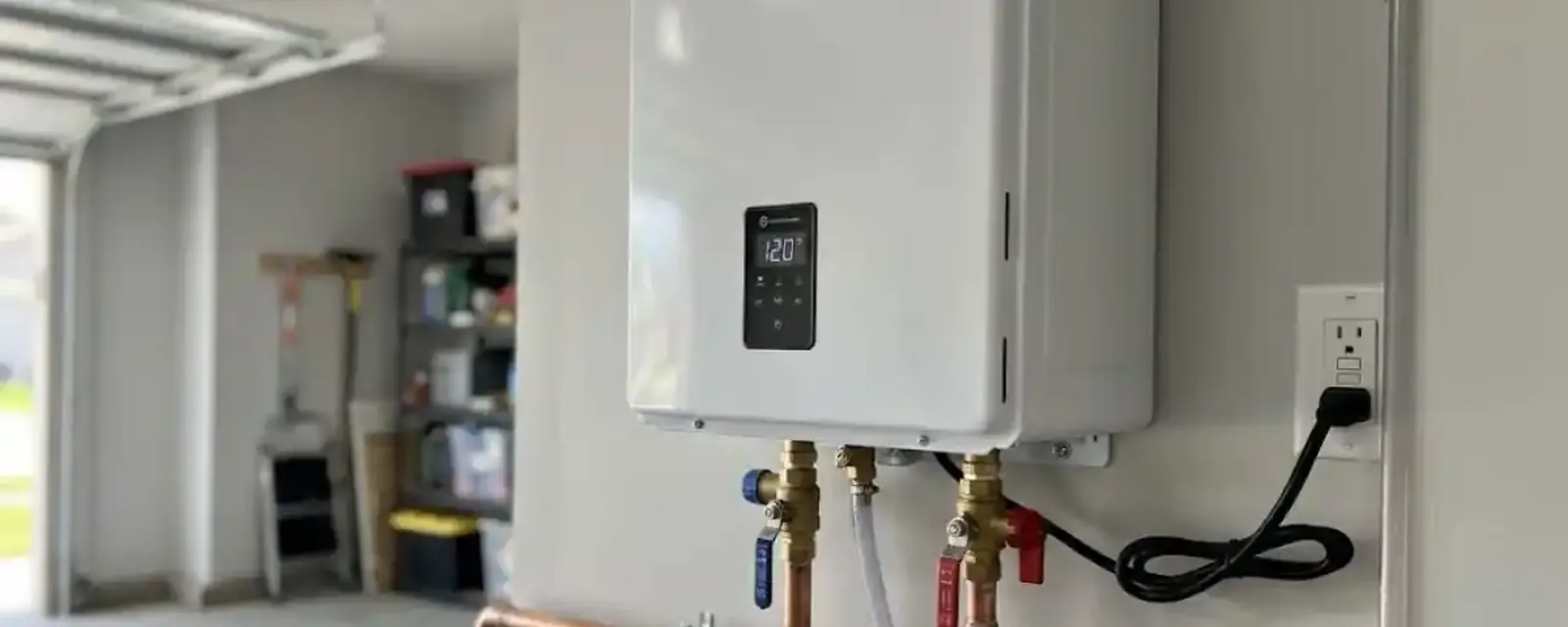
Why people switch to tankless, and why some should not
A tankless heater warms water as it flows, so there is no tank to run empty or hold standby heat. For a household that runs showers back to back or a family that has outgrown a 40-gallon tank, that is a big change.
It is not right for every house. The unit needs the right gas or electrical capacity, proper venting and a realistic look at how many fixtures run at once. We would rather talk you out of a poor fit than sell it.
Signs a tankless heater could fit your home
You run out of hot water
A bigger household or soaking tub can outrun a tank.
Your tank is aging
A replacement is a natural time to change technology.
Space is tight
A wall-mounted unit frees floor area in a closet or garage.
Gas or capable electric service
Capacity is the main requirement for a smooth install.
Salisbury water helps tankless units
The biggest enemy of a tankless heater is mineral scale inside the heat exchanger. Salisbury-Rowan Utilities supplies soft water, and East Spencer's published report lists hardness near 23 ppm, so scale should build slowly here compared with hard-water regions.
That does not remove maintenance. Manufacturers still recommend periodic flushing, and your plumber can set a schedule that matches your usage and your unit.
Tankless versus tank in practice
| Question | Tankless | Tank |
|---|---|---|
| Runs out of hot water? | Not at normal flow | Yes, when the tank drains. |
| Space | Wall mounted, compact | Floor space needed. |
| Upfront cost | Higher | Lower. |
| Install complexity | May need venting and gas upgrades | Usually simple swap. |
| Service | Periodic flush | Anode and flush. |
What installation involves
A tankless unit usually needs new venting, a properly sized gas line or electrical circuit, a condensate drain for high-efficiency models and isolation valves for flushing. Many Salisbury homes built before the 1980s were not designed for these, so we survey the house before quoting.
If you are comparing against a standard tank, see water heater replacement. For new locations and fuel changes, the installation page covers the planning steps.
What affects the price of a tankless install
A tankless project is priced after we see your house.
Insurance does not usually cover a voluntary upgrade. Some utilities and manufacturers offer rebates, so check before you buy.
To discuss tankless for your home, call (704) 951-1635.
Sizing a tankless heater for the way your household lives
Flow rate is the number that matters. We add up the fixtures that run together, such as a shower and a dishwasher, and match the unit's capacity to that demand at your incoming water temperature.
A unit that is too small gives you lukewarm water when two fixtures run. A unit that is too large costs more than it needs to, so a short conversation about your household saves money either way.
If you are deciding between technologies, ask us to price a standard tank beside the tankless option. Seeing both numbers makes the choice much easier.
Service and flushing for a tankless unit
Annual or periodic flushing and descaling removes mineral buildup, and cleaning the inlet filter keeps flow steady. Error codes often point to venting, flow or ignition problems that a technician can read quickly.
Soft water in this area lowers the risk, but it does not remove the need for service entirely.
Code and standards for tankless water heater
Tankless installs involve venting, gas piping or heavy electrical circuits. The plumbing side follows the International Plumbing Code (IPC) as adopted in North Carolina, and electric units also fall under the National Electrical Code (NEC).
Manufacturer instructions are part of the standard too, and a good installer follows them to the letter.
Tankless questions Salisbury homeowners ask
Many are rated for around twenty years with maintenance, longer than a typical tank. Real life depends on water quality and flushing.
Yes. Periodic flushing and filter cleaning keep it efficient, and we can set up a schedule.
Often. Tankless units draw a lot of gas at once, so the existing line may need an upgrade. We check this during the site visit.
Usually, if the unit is sized for your fixtures. We calculate flow based on what runs at the same time.
Yes. Error codes, no-heat conditions and scale buildup are common service calls. For broken units, ask about water heater repair first.