How to know if a sewer line is leaking
A leaking sewer line usually shows up as a persistent sewer odor outside, a soggy or unusually green patch above the line, slow drains throughout the house or a sunken area in the lawn. A single slow sink is rarely a sewer line problem. Several fixtures behaving badly at once is.
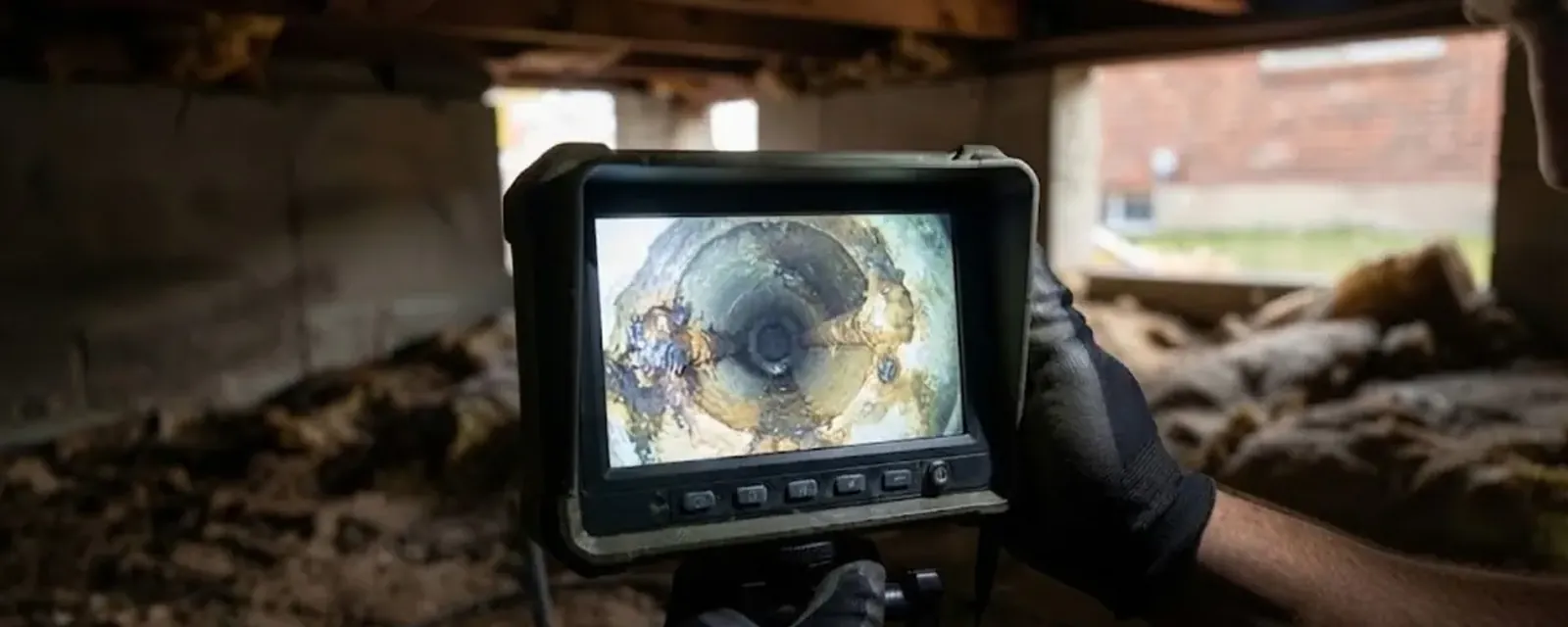
The only way to confirm a leak is to look inside the pipe. A plumber runs a camera through the line, then uses a locator to mark where any defect sits and how deep it is. Our sewer camera inspection service does exactly that.
Signs worth acting on
Odor in the yard
Sewage smell near one spot suggests waste is reaching the soil.
Lush patch of grass
Waste water fertilizes the grass above a break.
Gurgling in several drains
Air and water are fighting through a restricted line.
Mold or damp smell in a crawl space
Leaks near the house can wet the soil under it.
Rodents or insects near the foundation
Broken lines give pests a path.
Sinkholes or soft ground
Soil washes into a cracked pipe.
What a camera inspection costs you in time, not just money
A typical inspection takes about an hour once the plumber has access to the line. You do not need to be home for the whole visit, but being there for the last ten minutes lets the plumber show you the footage while it is fresh.
Ask for the recording and a short written note on what was seen, where and how deep. That record is useful if you ever sell the house, file an insurance claim or compare quotes from two companies.
Why sewer lines leak in older neighborhoods
Most sewer leaks come from joints that opened, pipe that cracked or roots that pushed in. Clay pipe has many joints, and cast iron corrodes from the inside. Plastic pipe rarely rots, but it can sag or separate if soil shifts.
Mature trees along older streets make roots a common cause. A fine root finds the smallest gap in a joint and grows into a mat that eventually catches paper and slows the flow.
A word on dye tests and smoke tests
Some plumbers add a dye test to see where water goes, or a smoke test to find vent and drain leaks above ground. These are useful for specific questions, like a sewer smell inside the house, but they do not replace a camera for a buried line.
If a company suggests digging before it has looked inside the pipe, ask why. Most sewer problems can be seen first and dug second.
How a leak search works
Interview and access
We ask about symptoms and locate a cleanout or pull a toilet for access.
Camera run
We feed the camera through the line and record what it sees.
Locate the defect
A locator above ground marks the depth and position of any problem.
Options and price
We explain whether cleaning, lining or replacement is the right fix.
Preventing the next leak
Keep tree roots in mind when you plant. Large trees over the lateral are a long-term risk, and a camera check every few years is cheap insurance for an older line.
Avoid flushing wipes and grease, and do not drive heavy equipment over the lateral. Small habits protect a pipe you cannot see.
What the camera might show
Each finding points to a different next step.
| Camera finding | What it means | Likely next step |
|---|---|---|
| Roots at a joint | Water is getting in or out | Cut roots, then plan a repair. |
| Offset joint | Pipe sections have separated | Spot repair. |
| Cracked pipe | A longitudinal or circular break | Repair or lining. |
| Belly with standing water | Pipe has sagged | Monitor or replace the section. |
| Clean, intact pipe | No defect | Look at other causes. |
What to do before the plumber arrives
A little prep makes the search faster.
- Find your cleanout, often a capped pipe near the foundation.
- Note where odors or wet spots appear.
- Stop watering the area so wet soil does not hide the leak.
- Gather any records of past sewer work.
- Do not pour chemical cleaners into the drains.
Who handles the sewer in Salisbury and nearby towns
Salisbury-Rowan Utilities provides water and sewer service for Salisbury, Spencer, East Spencer, Granite Quarry, China Grove and Landis, plus parts of unincorporated Rowan County. In general, the property owner maintains the lateral that runs from the house to the public main, and the utility maintains the main itself.
If a camera shows a problem near the main or in the street, contact SRU customer service with the footage. For work on your side, plumbing work in Salisbury is regulated under the plumbing section of the North Carolina State Building Code, which is based on the International Plumbing Code (IPC), and the City's Development Services office at 132 N. Main St issues permits when they are required.
Where this matters most around Salisbury
Older homes in Fulton Heights, built between about 1903 and 1948, and in Spencer are the most likely to have clay or cast iron laterals. Granite Quarry homes may sit on rockier ground that affects repair methods, and our Granite Quarry page explains how.
Newer subdivisions usually have PVC or ABS pipe, where problems tend to be sagging or poor joints. A camera tells you which situation you have, and it is far cheaper than guessing.
Signs that the leak is on the street side instead
If the camera shows a clean lateral all the way to the main and the problem appears near the street, the defect may be in the public main or at the tap. In that case, the utility owns the repair, and your footage is the best evidence you can give them.
Call Salisbury-Rowan Utilities customer service, describe what the camera showed and give them the distance from your cleanout. A clear report gets a crew to the right spot faster.
What happens after the leak is found
A small defect may only need a sewer line repair at one spot. If a long run is cracked, lining the pipe from the inside can avoid digging up the yard. A collapsed section needs excavation.
Ask for the recording, the depth of the defect and the price of each method. A good plumber gives all three without pressure.
Local questions answered
Usually the homeowner for the lateral from the house to the public main, and Salisbury-Rowan Utilities for the main. SRU customer service can confirm where the line divides for your address.
Yes. The locator marks the position and depth on the surface, even beneath paving.
It can be. Sewage in the house or active backups call for the 24/7 line. A slow yard leak is urgent but not always an emergency.
Often not for wear or root damage, but some policies add sewer line coverage. Check yours before repairs.
They tend to, because clay and cast iron lines age and tree roots are larger. Age alone does not mean a line has failed.